
Who pays for temporary housing after a house fire?
Your homeowners or renters insurer may pay reasonable extra living costs if a covered fire makes your home unfit to live in. Look for “loss of use” or “additional living expense” in your policy. Before committing to a long stay, ask which dates, rates, and receipts the insurer will accept. Start tracking the difference between ordinary spending and fire-related increases on your first night away. [1] [2]
Fire Advocate editorial guide | U.S. homeowners and renters
General insurance information. Coverage depends on the policy in force at the time of the loss, applicable law, and the facts of the claim.
In this guide
Seven facts to keep beside your claim number
1. A building owner’s policy and a tenant’s own renters policy are separate contracts. If you rent, report your displacement to your own insurer even if the landlord already has a claim. [6]
2. Additional living expense, usually shortened to ALE, addresses the extra cost of living elsewhere after a covered loss. It generally does not replace the money you already set aside for a mortgage payment. [1]
3. A room that costs $170 a night can cost considerably more after mandatory fees, parking, taxes, and the meals you cannot cook there. Compare the total for the household.
4. Policies can have both a dollar limit and a time limit. A housing approval for one week does not tell you whether the next week is approved. [4]
5. An expense paid directly by the insurer still belongs in your records. Mark it as paid directly so you do not submit it again. [7]
6. Keep the itemized receipt as well as proof of payment. A credit card statement may show who received your money without showing whether you paid for a room, a refundable deposit, or dinner. [8]
7. Keep questions about temporary housing separate from repair estimates and damaged belongings. Ask which coverage the insurer charged for each payment. [4] [7]
Where should I start if I need somewhere to sleep tonight?
Begin with a safe place for your household and one call to the insurer’s claims line. Give the policy address, the date of the fire, a safe callback method, and the number of people who need housing. Ask whether the insurer can arrange a room directly, whether you should book it yourself, and what record it needs tomorrow. [2] [3]
The useful question on that first call is concrete. “We have two adults and two children. The fire department told us we cannot stay here tonight. I have found a room nearby for $165 plus taxes. Can you arrange the stay or tell me what rate you are authorizing?” The answer may be a reservation, an approval up to a stated rate, or a request for more information. Write down exactly which you received. “We have opened your claim” tells you the claim exists. It does not give you a room reservation.
If the room is being arranged for you, ask the hotel or housing coordinator for the check-in name, reservation number, approved nights, and any charges still due at the desk. Hotels may ask for a card for incidentals even when someone else pays for the room. Ask what amount will be held and how the hold is released. A temporary hold, a final charge, and a deposit are three different things to enter in your record.
If you cannot reach the insurer and have to book, keep the confirmation and final hotel bill. Write a short note about why you needed that location and how long you initially booked. If an official told you to stay out, record who gave the instruction and how you received it. Do not go back into a home authorities have closed to collect a receipt. Receipts can often be reissued, and an adjuster can tell you what other evidence will work. Safety and recovery guidance from the U.S. Fire Administration addresses the first hours after a residential fire. [11]
What exactly am I looking for in the policy?
Read the declarations, the loss-of-use section, and any endorsements that change that section. Look for who is insured, which residence the policy covers, the event that triggers payment, and any limits on time or money. Ask the adjuster to identify the specific section being applied. A summary from an agent or website cannot settle a question about your individual wording. [1] [6]
A declarations page is a useful starting point because it puts policy dates, limits, and coverage names in one place. On some policies, loss of use is called Coverage D. On others, the heading differs. A limit may be expressed as a dollar amount or tied to another coverage amount. Do not assume the amount beside the building limit is also available for housing. If several benefits sit under one loss-of-use heading, ask whether they share one limit. Write down the insurer’s answer instead of assigning the whole amount to lodging in your household budget.
Try a one-page policy note. Under “trigger,” copy the relevant sentence from your own policy. Under “time,” record how the insurer says the period starts and ends. Under “money,” enter the limit or the explanation if there is no fixed dollar figure on the declarations. Under “unanswered,” write the questions the policy does not resolve for you. You can now ask “Does this endorsement change the time period on page 18?” instead of repeating the entire story whenever the assigned representative changes.
Date the note and save the actual policy that was in force on the fire date. A renewal can look nearly identical but contain a different limit, endorsement, or deductible. If the only copy you have is a current online summary, ask for the full policy and endorsements for the date of loss. If you rent, locate the policy for your unit and the personal property insured there. Massachusetts explains the different roles of homeowners, condominium, and renters coverages in its consumer guide. Its descriptions are a starting point for questions, not a substitute for another state’s rules. [6]
How do I decide what counts as an extra living expense?
Start with a comparison for the same household, expense category, and period. Write what you actually spent while displaced, what you would ordinarily have spent, and why the difference arose. The amount left is a candidate for the adjuster to review. Recording it does not mean the policy covers it. Food, additional travel, and temporary lodging can involve different calculations. [1] [4] [5]
Suppose your household normally spends about $150 a week on groceries and $35 on takeout. During a week in a hotel with no stove, you spend $65 on groceries and $260 on prepared meals. The displaced food total is $325. The ordinary food total is $185. The difference is $140. Reporting $260 as the entire increase would overlook both the groceries you still bought and the food you normally pay for. Your adjuster might apply a different method, but this record shows the facts behind your figure.
Ordinary spending can be hard to establish when paydays, groceries bought in bulk, or alternating child-care arrangements make one week unrepresentative. Use a reasonable period from before the fire, identify it clearly, and preserve the records you relied on. If one week contained an unusual birthday dinner, do not silently remove it to produce a more favorable difference. Explain whether it was typical and provide enough context for someone else to see how you reached the estimate. Mark estimates separately from amounts supported by itemized bills.
Keep the boundaries of the comparison consistent. A weekly food comparison works poorly if a grocery receipt includes a new suitcase and toiletries. Move the nonfood items to separate lines and ask where they belong, if anywhere. The cost of replacing belongings is a different question from the extra meal expense caused by staying in a hotel. Maryland’s post-disaster questions include a food example that illustrates the difference between ordinary and increased costs. [5]
How do I compare a hotel with a furnished apartment?
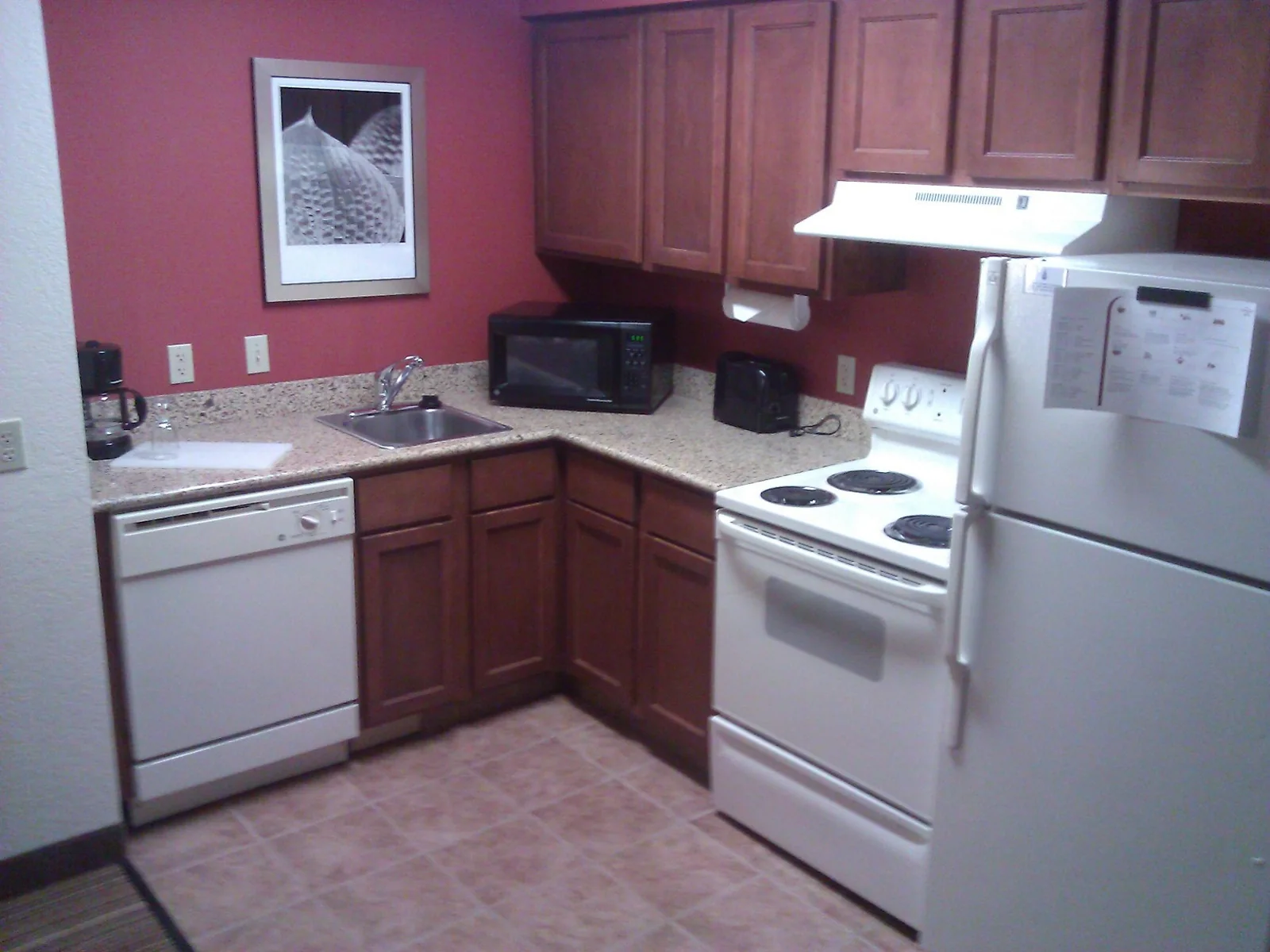
Photograph by Spindocter123. Wikimedia Commons · CC BY-SA 3.0. Resized for this guide.

Compare two realistic options over the likely length of stay. Include compulsory charges and the ordinary activities the accommodation allows. A hotel that works for two nights may be a poor fit for three weeks. Ask the insurer to approve the arrangement and explain the consequences if repairs finish early or take longer. Get the answer before signing a rental agreement when possible. [2] [3]
Imagine the first option costs $162 per night including tax for fourteen nights, or $2,268. The room has no kitchen. You estimate $140 in additional food costs per week and need $12 per night for parking. The projected displacement costs for this comparison are $2,268 plus $280 plus $168, for $2,716. The second option is a furnished apartment at $1,950 for the same dates with a $145 cleaning fee, free parking, and a usable kitchen. Its projected cost is $2,095 before any other fees. These figures illustrate a choice, not a market rate or insurance entitlement.
Make a separate line for a refundable deposit. It matters to your cash flow even if it eventually comes back and should never be reported as a permanent expense unless there is an actual charge and the adjuster considers it. If the apartment requires a full calendar month or cannot be canceled, put the nonrefundable commitment beside the two-week estimate. A lower displayed nightly rate can become the more expensive option when the terms bind you for unused nights.
Then record the practical constraints. A ground-floor entrance may be essential. A child may need to remain near a school bus stop. A rental without pet accommodation may require separate boarding. Tell the insurer what the household needs without sending personal medical records to a booking company. Ask which details are necessary, who will see them, and how to share them if the insurer needs supporting information. A concise description of the access need is often a better starting point than sharing an entire file.
If the insurer proposes housing, check the listing yourself. Confirm who is allowed to occupy it, whether utilities are included, who handles maintenance, and what happens at the scheduled end of the stay. Save the listing and written approval together. That pairing lets you reconstruct what you agreed to even if the listing later disappears or the quoted price changes.
What should I put in the expense log?
Give each expense a date, a clear description, the amount actually charged, the ordinary cost if relevant, and a receipt reference. Also record who paid and whether the insurer has approved, paid, or questioned the item. A simple log you can update in a hotel lobby is more useful than a complex workbook you abandon after the first week. [7] [8]
Use one row per meaningful charge. For a hotel, a single row can cover a stay if the final folio itemizes the nights and the same arrangements applied throughout. If the insurer paid for three nights and you paid for two, use two rows. If the hotel moves you to a different rate after a weekend, either split the row or write the rate change in a note. You want a reviewer to be able to tell which dates and dollars are still under consideration.
Consider these sample entries. On October 10, a two-night hotel bill is $346, the insurer pays the hotel directly, and your out-of-pocket balance for the room is zero. On October 11, a laundry service costs $24 because you cannot use your washer. Enter $24 as paid, leave the ordinary baseline open if you have not worked it out, and write “awaiting adjuster guidance” under the amount requested. On October 12, you place a $200 refundable deposit with a landlord. Enter it as a deposit and set a reminder to check for the refund. Those are three separate events. Adding them together as $570 due to you would produce a misleading request.
Keep a second sheet or note for changes after submission. A card refund can arrive after you send the receipt. A hotel may credit one night after you have checked out. Send a short correction with the claim number, the original row reference, the credit date and amount, and the updated total. Preserve the original row and mark it corrected. This is easier to explain than a spreadsheet in which yesterday’s numbers vanish without explanation.
For paper receipts, photograph the whole receipt on a plain surface while the date, tax, and total are still legible. Give the file a name such as “Oct-12_laundry_24.” If you use one device for the household, decide who will upload receipts and when. Store a backup in a location you control. Send the insurer only what is needed for the item, through its confirmed claims channel. A bank statement authorized for a food comparison does not need to become a general record of unrelated purchases.
How do I keep an advance from getting counted twice?
Record the amount, date, payee, and coverage named on each payment letter. An advance provides cash while a claim is developing. The insurer can count it toward the eventual payment for that coverage. Ask how it is applying the money, especially if one payment letter mentions both belongings and temporary living costs. [7]
Here is one way a straightforward reconciliation works. The insurer advances $900 specifically for ALE. You then submit $1,180 in eligible, documented expenses you paid. If the insurer approves the full $1,180 and there are no other adjustments, the advance would leave $280 unpaid on those items. The advance is not another $900 expense to add to the submission. If the insurer also paid a $420 hotel bill directly, list that hotel stay under “paid to vendor.” Do not request the same $420 as reimbursement for a charge you never paid.
Now change just one fact. The $900 letter says “personal property advance.” You should no longer deduct it from ALE in your own accounting without clarification. Save the letter, ask which coverage ledger the insurer used, and keep the two categories distinct while you await a response. A check’s arrival date can tell you when you received the money. It cannot tell you which coverage the insurer intended to charge.
Ask for a written statement if the numbers no longer agree. A useful request is “Please show the approved expense total for October, amounts paid directly to vendors, advances applied to this coverage, and the remaining reimbursement.” Include the dates of the statements you are comparing. A discrepancy sometimes comes from a payment issued at the end of one period but received at the beginning of another. Matching entries by amount and payee before escalating the dispute can save an entire round of correspondence.
What if the house still stands, but I cannot live there?
Explain the specific reason the residence cannot be occupied and ask which policy provision applies. Damage to the house, a restriction on access, and a precautionary departure can present different coverage questions. An evacuation order can matter, but it does not establish every condition of every policy. Preserve the order or inspection notice and record the dates it applies. [3] [9] [10]
A house can look intact from the street while an inspector prohibits entry or essential rooms are closed. If an official or qualified professional provides a written restriction, save a copy and note the property address. If you receive only verbal instructions, record the date, name or office, and the exact limitation as you understood it. Ask whether a written copy will follow. You can tell the insurer “the inspector restricted occupancy pending an electrical inspection” without offering your own opinion about when the building will be safe.
A neighborhood evacuation can create a different question. Keep the actual order, the geographic area it covers, and any later notice allowing residents to return. Some policy provisions for prohibited use or civil authority have conditions or time periods different from the provisions for physical damage at your own address. Ask which provision is being evaluated. If officials lift a neighborhood restriction while your individual house remains unsafe, document both dates. The sequence matters more than a single label such as “evacuated.”
Do not treat the insurer’s lodging decision as a safety inspection. An approval ending on Friday tells you something about payment through Friday. It does not certify the home is safe on Saturday. The reverse is also true: a contractor’s estimate that repairs will last until February helps explain the situation, but it is not a February housing approval. Keep the authority for occupancy, the repair schedule, and the insurer’s decision in separate columns so you can see which question still needs an answer.
How can I tell whether my housing budget will last?
Ask the insurer for the applicable dollar limit, any time limit, the period already approved, and the total charged to the limit so far. Include direct-billed lodging when estimating what remains. Then compare several repair dates rather than relying on a single predicted move-in day. A planning estimate can identify a gap early enough to discuss it. [3] [4]
Suppose your adjuster confirms a $15,000 dollar limit and says $3,600 in approved extra costs has already been charged against it. That leaves $11,400 before later adjustments. If your projected extra cost is about $2,850 a month, the arithmetic allows roughly four more months at that rate. If a repair estimate changes to six months, the projection raises a question immediately. It does not mean the insurer has agreed to four more months, much less six. Coverage conditions and any applicable time limit still matter.
Forecast in two different units if your accommodation charges weekly but your repair estimate is monthly. Thirty nights at $150 is $4,500. Four seven-night weeks at the same rate cost $4,200. A budget that treats every month as four weeks silently loses two or three nights of lodging most months. Over a long repair that difference can be material. Use actual dates for reservations and calendar dates for the insurer’s authorizations.
Revisit the numbers when conditions change. A furnished rental with a kitchen might reduce your extra food costs, while a location farther from work could increase transportation costs. If the insurer proposes moving from the hotel to an apartment, calculate both effects and note any one-time costs such as moving belongings between the two accommodations. The point is to give the adjuster a realistic household comparison before a lease is signed, and to give yourself a usable picture of future out-of-pocket costs.
Create three reminders when you receive a housing approval. One is for the last approved night, one for the last day you can cancel or extend without a penalty, and one for the date the insurer wants the next repair update. These can fall on different days. If the contractor has not yet issued a written revision, send what you know, identify what remains uncertain, and ask what interim documentation the insurer will accept. Do not change a contractor’s estimate to match the date you hope to secure.
What should a useful reimbursement request actually say?
State the claim number, coverage category, exact dates, amount you paid, and what you are asking the insurer to do. Separate new items from earlier submissions and direct payments. Attach a short index and the supporting records. If you still lack a receipt or an answer about coverage, identify that gap so the rest of the submission can be reviewed. [7] [8]
For example: “Please review the attached additional living expenses for October 10 through October 16. We paid $485. Our log identifies $115 in estimated ordinary food costs, so the amount submitted for review is $370. The two hotel nights you paid directly are listed for context and excluded from the $370. Please tell us if you need further records and how the earlier advance will be applied.” Replace every sample number before using the wording. The person reviewing your request should be able to reproduce your total quickly.
If the insurer requests “more documentation,” ask which row, which figure, and what alternative it will accept. There is a practical difference between a missing hotel folio, an unexplained food baseline, and an expense the insurer considers outside the policy. A replacement folio can fix the first issue. A grocery comparison may resolve the second. For the third, request the policy language and written reasoning before gathering a drawerful of irrelevant receipts.
If a payment is smaller than expected, ask for an itemized determination. Compare the requested amount, approved amount, advance applied, direct payment, and amount still under review. Ask whether a disputed item was declined, reduced, or deferred. A deferred item with an identified missing document calls for a different next step from a final denial based on a policy provision. Save the written answer with the original submission so later reviewers can follow what changed.
If the explanation is still unclear, use the insurer’s complaint or escalation channel. Your state insurance department can tell you how to make a consumer complaint and what information its process requires. Identify the issue you want reviewed, such as the wording the insurer relied on or a payment you cannot reconcile. Whether you also need independent legal advice depends on your situation, especially if you have received a formal denial or a notice with a deadline. Do not assume a complaint extends the time to take another step.
What if I stay with relatives, rent my home, or have to board a pet?
Explain your actual arrangement and ask about it before treating a particular payment as eligible. Staying with family, paying rent for an unusable apartment, or boarding an animal can raise different questions. Report only real costs, record who paid them, and keep a clear distinction between an amount you incurred and an amount you are considering. [1] [4] [6]
If relatives invite you to stay for free, you have no hotel bill to submit. You may still have other extra costs. For instance, a longer trip to work may add mileage or transit fares. Explain where you started before and after the fire, the number of trips, and the extra cost you actually incurred. If a relative asks you to contribute toward groceries, record what you paid and how it relates to your ordinary grocery spending. Do not create a backdated lease or a nightly rate for an arrangement that was free.
If there is a genuine rental arrangement with a relative, tell the adjuster who the host is and ask in advance what documentation the insurer needs. A written agreement, proof that money changed hands, and the dates you actually occupied the space can make the arrangement understandable. A relative can help without becoming a claims expert. Give them the specific document request instead of asking them to sign a broad statement about what your policy owes.
If you are a tenant, your landlord may be talking to a building insurer while you are talking to a renters insurer. Keep those conversations separate. Your landlord can often supply practical information about access and repairs, but the landlord cannot confirm what your renters insurer will reimburse. If the building owner offers another unit at no additional rent, tell your insurer; the actual costs may change. Ask separately about your lease and any rent still due. ALE is not a ruling on either party’s obligations under local landlord-tenant law.
For pet accommodation, compare a pet-friendly hotel with a hotel plus boarding. For illustration, an additional $25 nightly pet fee at one hotel could cost less than separate boarding and transport. Photograph the quoted terms, show the dates, and ask what the insurer will allow. Keep pet food separate from boarding: your pet needed food before the fire, so ordinary food alone does not demonstrate an increase. A household with a service animal may have different accommodation needs. Describe the practical need, and seek qualified local help if access is disputed.
What should I check before I close out temporary housing?
Match the last night you stayed with the last night paid, review outstanding deposits, and reconcile the insurer’s summary with your own records. Confirm whether any submitted items are still pending. Keep the final folio, rental checkout statement, payment letters, and any written decisions together, even if repairs or a separate contents claim will remain open. [7] [8]
Start with vendors. A hotel booking confirmation is not always the final bill. Ask for a folio showing all nights and payments, including any paid by the insurer. If you leased an apartment, keep the checkout report, final utility charge, deposit refund, and forwarding instructions. A late refund can change a claim already submitted. Write down how to notify the insurer and leave the coverage line open in your own records until the refund is accounted for.
Next, match the insurer’s entries to your own. A vendor payment that never went through your bank can still explain part of the amount exhausted under a policy limit. A payment marked “issued” may be a paper check you have not received. An older advance may have been reconciled against a later batch of receipts. Ask for written clarification of unmatched lines. Keeping a log is not about making the company use your format. It gives you the information you need to check the total.
Finally, read any document asking for a signature. A receipt for a payment, an acknowledgment of dates, and a release can have different consequences. If the wording appears broader than the expense being discussed, ask what the document would resolve and consider independent advice before signing. Keep the unsigned version while you seek clarification. A move back home is a practical milestone. It does not, by itself, answer every question about repairs, belongings, or another outstanding part of the claim.
Frequently asked questions
Can I claim the entire restaurant bill if my hotel has no kitchen?
The insurer generally looks at the increase over ordinary food spending. Keep the itemized restaurant bill, grocery receipts from the same period, and a reasonable comparison from before the fire. Explain what changed in the temporary accommodation. If you share an expense with another displaced household, identify the portion you actually paid. [1] [5]
Should I wait for the adjuster before finding a room?
If you need safe shelter immediately, seek it. When practical, call the insurer first about direct booking, rate limits, and reimbursement. If you arrange the first night on your own, retain the actual bill and explain why you needed the accommodation. Confirm further nights directly with the insurer as soon as possible. [3] [11]
What if I cannot afford to pay and wait for reimbursement?
Tell the adjuster that upfront cost is the immediate problem. Ask about direct hotel billing, a housing coordinator, or an advance and how it would be reconciled. Ask for a reservation number or written instructions before relying on an arrangement. The California claims guide describes advances, though availability and procedures can differ elsewhere. [7]
Does paying my regular mortgage increase my ALE claim?
An ordinary mortgage payment is generally still the homeowner’s responsibility. The expense being considered is the extra cost of living elsewhere after the covered loss. If a lender has offered a temporary payment arrangement, keep that communication in a separate file and direct housing coverage questions to the insurer. [1] [5]
Is a mandatory evacuation enough on its own?
Read the relevant policy provision and give the insurer the actual order. Whether the insurer will pay can depend on why access was restricted, whether covered damage occurred, the length of the restriction, and state-specific protections. Keep the order date, geographic boundaries, and lifting date. Wildfire guidance should be read in the context of the event and state it addresses. [9] [10]
What if I lose an itemized receipt?
Ask the vendor for a replacement first. If the vendor cannot help, send the adjuster an honest explanation and ask whether a card record, booking confirmation, dated email, or other evidence is acceptable. Describe what each record actually establishes. Do not label a reconstructed estimate as an original receipt. [7] [8]
Does a request to Fire Advocate notify my insurance company?
No. Contact your insurer directly to report a fire loss, request accommodation, submit receipts, or dispute its decision. Fire Advocate provides information and accepts non-urgent inquiries. Submitting its form does not file an insurance claim, hire a lawyer, or preserve a deadline. Use the site’s contact page if you want a response about available next steps. [12]
Sources and further reading
The national sources explain common insurance terms. State regulators describe practices and rules in their jurisdictions. The numbers in the worked examples are hypothetical household budgets. They do not represent an insurance offer or a prediction of what a claim will pay.
1. National Association of Insurance Commissioners • What are additional living expenses?
2. Oregon Division of Financial Regulation • Wildfire evacuation and insurance resources
3. Texas Department of Insurance • When do policies pay additional living expenses?
4. Maryland Insurance Administration • Additional living expenses and limits
5. Maryland Insurance Administration • Post-disaster insurance claim questions
6. Massachusetts Division of Insurance • Understanding home insurance
7. California Department of Insurance • Residential property claims guide
8. Maine Bureau of Insurance • Post-disaster claims guide
9. Texas Department of Insurance • Fire, smoke, and explosion damage questions
10. National Association of Insurance Commissioners • After a wildfire